ALTER13 : Premise Table
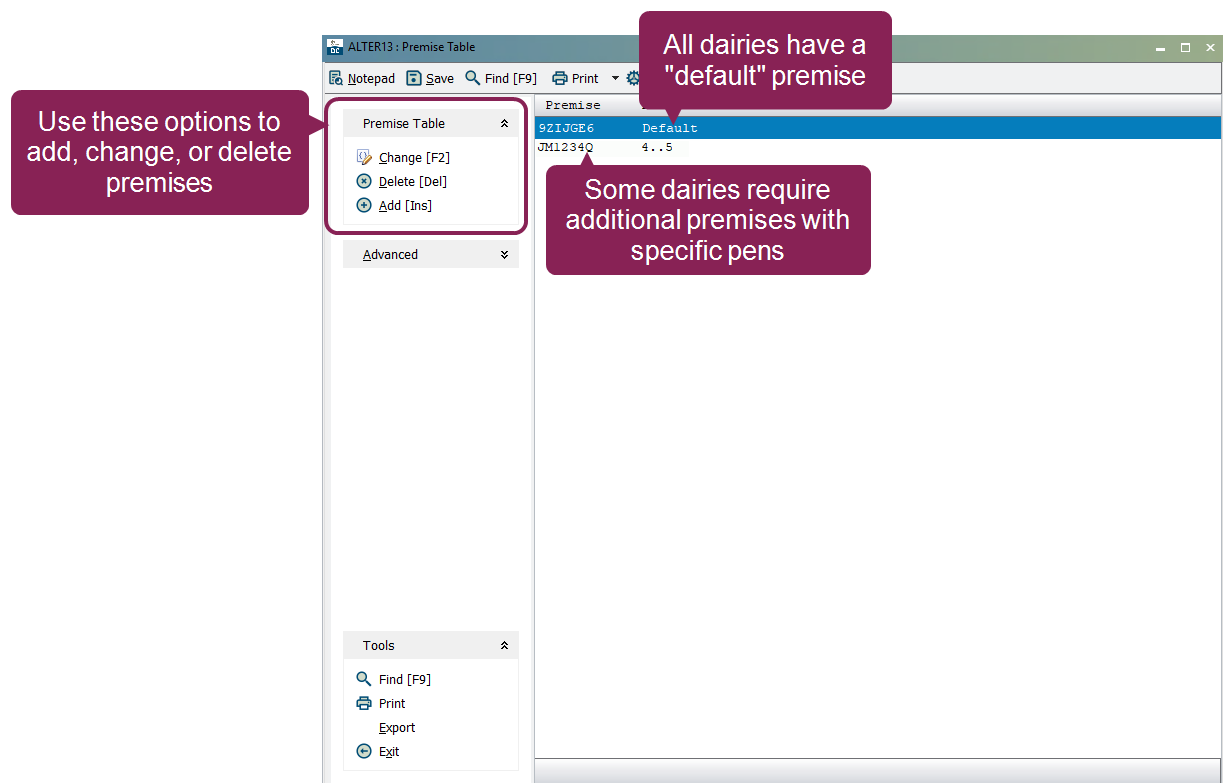
The ALTER13 : Premise Table option in DairyComp allows you to manage physical location identifiers (premise IDs) for your dairy. This table is a critical component of national traceability programs, linking physical addresses to pens within your herd.
The primary purpose of this program is to maintain a database that allows for rapid traceback of animals in the event of a disease concern, such as bovine spongiform encephalopathy (BSE). By identifying where an animal is (and has been), the system ensures the safety of the food supply.
To open the Premise Table window, enter Alter\13 or type ALTER and choose [D] Define Premises Table from the menu.
Expand the sections below to learn more:
 Understanding Premises and Pens
A dairy will have at least one premise, known as the default premise. While many dairies only use one premise ID, larger operations with distinct units (such as a heifer ranch or dry cow barn at a different address) may require multiple premise IDs.
DairyComp manages these locations by linking pens to premise IDs:
-
Default Premise: Any animal that is not assigned to a secondary premise is considered to be in the default location.
-
Premise Changes: When an animal is moved to a new pen, the system checks this table. If the new pen is linked to a different premise ID, DairyComp triggers a MOVE event or Traceability Location change.
Best Practices for Traceability
To ensure your premises data is accurate for government or industry reporting:
-
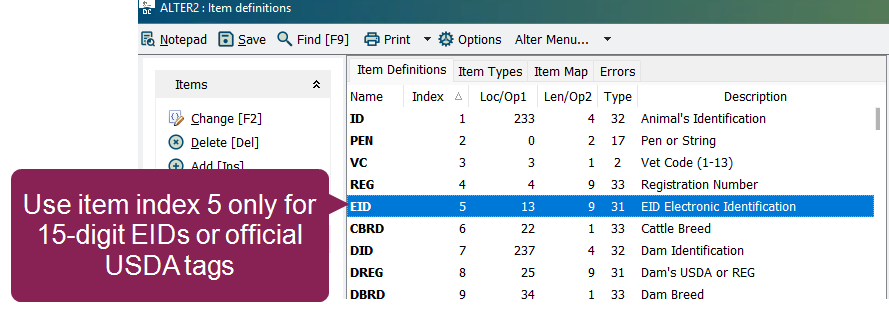
Maintain Animal IDs (item index 5): Premise identification only works if the animal’s unique ID is correct. It is highly recommended to use item index 5 only for 15-digit EIDs or official USDA tags. National databases use this ID alongside your premise ID to track an animal's lifetime movement. See ALTER2 : Item Definitions for more information about using DairyComp items.
-
Automatic Movement Tracking: You don't need to manually report a location change within DairyComp. When you move an animal to a new pen (using the ENTER command), DairyComp automatically checks if that pen belongs to a different premise ID. If it does, DairyComp flags a physical movement event for your traceability reports.
 Set Up or Change a Premise
Use the Change or Add options to manage your premise IDs. If the table is empty, the system immediately prompts you for a default premise ID.
Setting up a premise is a two-step process:
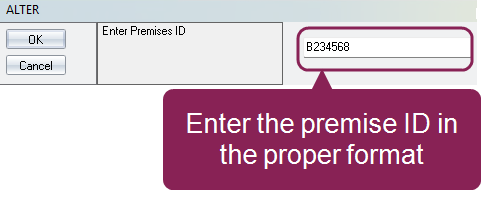
Step 1: Enter the Premise ID
When adding or changing a premise ID, you must enter the ID in a specific format. In the US, a premise ID must be a seven-character alphanumeric string. The seventh character is a mathematically calculated "checksum" of the first six.
Step 2: Assign Pens
Once a valid premise ID is accepted, DairyComp automatically prompts you to enter the associated pens. (This step is skipped for the default premise, as it automatically covers all pens not assigned elsewhere.)
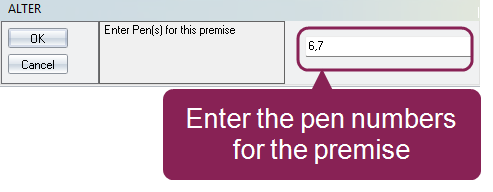
When the prompt appears, define pens for that premise ID using the following formatting:
-
Separate individual pens with commas (e.g., 2, 4, 6).
-
Define a range of pens using ellipses (e.g., 20..25).
After you click OK, the premise ID and its linked pens appear in the premise table.
Delete a Premise
Use the Delete option to remove a premise ID from the table. Once deleted, any pens previously assigned to that ID revert to the default premise.
Advanced Options
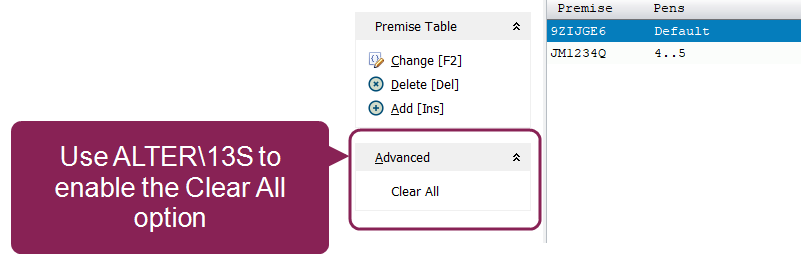
If you need to wipe the existing table and start over, use the command ALTER\13S. This switch enables a Clear All option within the window.
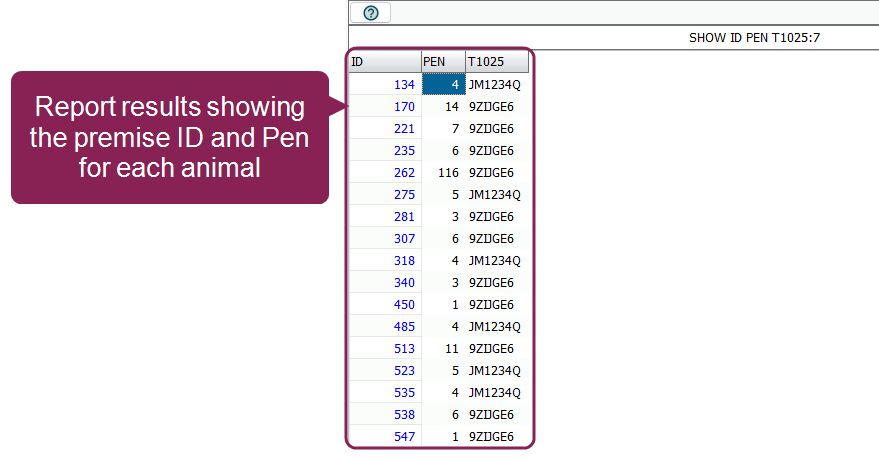
While premises are not stored as a standard animal item, you can display an animal's current premise in a report using a type 67 item. For example, the command SHOW ID PEN %67.1.1:7 displays the animal's ID, pen, and the full 7-character premise ID: